

 |
 |
 |
|
|
|


|
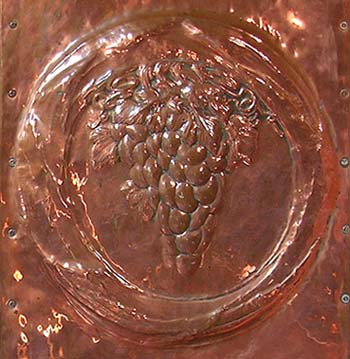
Towards an Interpretation of the Vine Motif on the Pulpit at St Mark’s BrithdirThe construction of the pulpit at St Mark’s caused both the artist and designer, Henry Wilson, and his patron, Mrs Louisa Tooth, a number of problems and frustrations. When the church was consecrated on 8th September 1897 by the bishop of Aberdeen, deputizing for the bishop of Bangor, the pulpit was unfinished. Only the plain wooden frame had been put in place.(1) Wilson had pointed out that the covering of beaten copper which he planned would allow nothing of the wooden framework to show. In fact, it was not until the end of December that the work was finished, and in a letter dated 28th December he describes what had been undertaken. “The panel on the pulpit has a text from the Vulgate on ‘Now gird up thy loins and say to them the things that I deliver thee’”. Wilson had worked on the pulpit panels in his studio, and he commented “The inscription in raised letters took a long while to do as it was all beaten up from the back of the metal and finally polished.”(2) Wilson was referring to the repousse technique, and he was not exaggerating the time it must have taken to work up his chosen text. The inscription is a long one, and the lettering complex and intricately ordered. He then went on to the design itself. “In the centre of each panel is a large circle, a wreath of leaves enclosing a bunch of grapes. The significance of this is obvious.”(3) There are two visual ‘puzzles’ on the pulpit which need elucidation; the one is the grapes, the other the chosen Vulgate text. To those puzzles we shall return. The work was evidently completed early in 1898. Mrs Tooth was a difficult patron to please, and with fixed opinions often forthrightly expressed. Her initial reaction was not favourable, and once again Wilson was put on the defensive. Writing to Mrs Tooth on 15 March, he said “Really the Pulpit does not look like a pot at all. It is really more in keeping with the simple character of the church than any combination of framing and copper could be…Logically to frame a metal panel in a wood one is wrong and aesthetically also. The strength should be in the frame and the eye however strong the frame may really be always gives more importance to the idea of strength given by the metal.”(4) Clearly Mrs Tooth had not liked the shape of the pulpit, and also had a more conventional design in mind, namely, framed panels as decoration. Not for the first time, she and Wilson were at cross-purposes.(5) Wilson may have been confident in 1898 that his design for the Brithdir pulpit was “obvious” in its significance, and equally confident that so committed and informed a Christian as Mrs Tooth would have appreciated it, but more than a century later, it is not so clear-cut and Wilson’s conception poses a number of intriguing questions. Not the least of these, as we have already noted, concerns his chosen text. In his letter of 28 December 1897, he quotes that text, Jeremiah 1 v. 17, in English, only mentioning that in execution, he has taken it from the Latin Vulgate. His editor comments “The use of the Vulgate is consistent with other Roman Catholic details in the arrangements of the church”(6) but this is a facile remark, and quite misses the point. In his later letter of 15 March 1898, Wilson makes it quite clear that the artistic inspiration for his design was the wall-pulpits to be seen in the churches of France and Italy.(7) Such pulpits would not have Biblical inscriptions from the Authorized Version, though one might feel that it would have been easy enough to have adapted the design to accommodate an English-language text. The use of Latin inscriptions on reredoses, lecterns, pulpits and in stained glass in buildings of the Established Church is one that needs further research. The Jeremiah text is not the one that comes most readily to mind in relation to preaching – 1 Corinthians 1 v. 23, “We preach Christ crucified…” for instance, was one more obvious (and commonly employed) choice. But Wilson was not interested in the commonplace, and the text, in Latin, though it would have been incomprehensible to the majority of those who occupied the pews, was appropriate at a number of levels.(8) The context was the prophetic ministry to which Jeremiah was called. The words are those of God Himself to his chosen prophet, and are words of encouragement. Jeremiah was a reluctant prophet (cf. ch. 1 v. 6), his task was to be a difficult one, and to be executed at a time of great uncertainty and upheaval. To ‘unwrap’ the full significance of Wilson’s chosen text it is essential to remember this context, and also bear in mind the whole of chapter 1. There is, for example, the typological significance of this chapter. Jeremiah had responded to God’s call by pleading “I do not know how to speak; I am only a child”. (v.6). But God’s choice of Jeremiah was fore-ordained As He told the prophet, “Before I formed you in the womb I knew you, before you were born I set you apart; I appointed you as a prophet to the nations”. (v.5).(9) The resonances with the Incarnation are inescapable, and it is the Incarnation, beginning with the annunciation to Mary that she has been chosen by God to bear His son, the one who is to be “a light to lighten the gentiles and the glory of thy people Israel”, (ie of all the nations), that is the subject of Wilson’s companion-piece to the pulpit, the altar frontal. Then there is what could be called the ecclesial context. Dolgellau, the parish out of which the Brithdir district was formed, had been an early centre of Tractarianism. Mrs Tooth was definitely sympathetic to that revival within nineteenth century Anglicanism, and to the Anglo-Catholicism which evolved from it. Her husband, Charles, had been a priest in that tradition, and her brother-in-law, Arthur, when vicar of St James, Hatcham, had suffered imprisonment for his defiance of the Public Worship Regulation Act of 1874. St Mark’s, Brithdir was to be a centre of Anglo-Catholicism, albeit in a muted form; the choice of the bishop of Aberdeen to perform the consecration would indicate that – apart from the fact that he and Mrs Tooth were related by marriage.(10) Then, the first vicar of Brithdir was also carefully chosen to co-incide with Mrs Tooth’s requirements. The Revd T.Llewelyn Williams, curate of Caernarfon, was thoroughly vetted by the Dean of Bangor, the Very Revd Evan Lewis, as to the soundness of his views. Lewis, a noted Tractarian, had been rector of Dolgellau, and both understood and sympathized with Mrs Tooth. Nonetheless, there was recognition that Anglo-Catholicism was still viewed with deep suspicion by many churchmen. Mr Williams could not necessarily expect an entirely smooth passage. And here the context of Wilson’s chosen text is relevant – as a coded message. “You must go to everyone I send you to and say whatever I command you. Do not be afraid of them, for I am with you and will rescue you, declares the Lord.” (vv. 7 and 8). “Get yourself ready! Stand up and say to them whatever I command you. Do not be terrified by them, or I will terrify you before them.” The chosen text here is virtually a repetition of the earlier assurance.(11) The occupants of the Brithdir pulpit had their commission and, by implication, the authority with which to carry it out – as well as a warning as to their fate if they failed. Before leaving the text, it is worth noting that as well as this coded reference, there is another, which, perhaps, betrays something of Wilson’s sense of humour. Verse 18, that which immediately follows the chosen words, reads: “Today I have made you into a fortified city, an iron pillar and a bronze wall to stand against the whole land…” The Hebrew could also be translated as “a strong bronze wall”, and the iron pillar (bar or bolt) has also something of the meaning of a cylinder around which the bronze wall is scrolled.(12) Is this not, effectively, what Wilson had done, in the innovative construction of the pulpit, with its copper panels “wrapped around” the frame?(13) For those who had eyes to see, and in a Bible-reading age that was a considerable number, the allusion was fairly obvious.
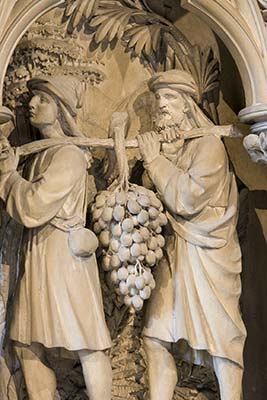
As Wilson indicated, in his letter of 28 December 1897, the principal motif of the pulpit panels was what he described as “a wreath of leaves enclosing a bunch of grapes”.(14) It is a somewhat prosaic description of a subject rich in symbolism. Worked in the same way as the inscription, that is, repousse, a technique Wilson himself described as “modelling in relief produced by working with hammer and punches on the back of a sheet of metal fixed on some yielding material”,(15) the design is a very attractive one. Given the association of the vine motif with the Eucharist, it may also seem, at first sight, an unusual one to employ on a pulpit, rather than on an altar reredos. When, however, it is understood that Jesus Christ is “the true locus amoenus, the earthly paradise made once more available to man and able to renew him”,(16) the emblem can be seen to be as appropriate for the pulpit as it is for the altar.(17) The underlying concept is that of paradise regained through fellowship and communion with Christ, a fellowship and communion forged and wrought both through the gospel preached and received and through the Eucharist. The governing text, and the inspiration for the motif of the cluster of grapes is Numbers 13, v. 23: “When they reached the valley of Eshcol, they cut off a branch bearing a single cluster of grapes. Two of them carried it on a pole between them, along with some pomegranates and figs”.(18) The context here is Moses’ commission to the leaders of the tribes of Israel to explore the land of Canaan, and then to report back with answers to a set of questions concerning its condition, fertility and settlement. (13 vv.18-20). Because of the way in which the cluster of grapes was transported back to the Israelites, still upon their exodus journey in the wilderness, the cluster came to be seen as a ‘type’ of Christ upon the cross. This understanding was reinforced by the way in which the vine itself was cultivated; it was espaliered, its branches and leaves in rows, as Christ’s arms were spread out upon the cross.(19) This is entirely in harmony with Jesus’ understanding of himself, as expressed in his High Priestly prayer at the Last Supper: “I am the true vine, and my Father is the gardener” (John 15 v.1.)(20) As F E Hutchinson noted, the two texts, Numbers 13 v. 23 and John 15 v.1, are intimately related: “The story of the Israelites journey to the Promised Land is also our story, because God’s righteous acts are prophetic and foreshadow our case too. And if we do not meet with their cluster of grapes, we have Christ ‘the true vine’.”(21)
The motif of the cluster can be found, for example, in the works of at least two late sixteenth and early seventeenth century poets, William Alabaster and George Herbert. This is not to say that Wilson himself was familiar with either, though Herbert’s work was perennially popular, but is illustrative of the fact that the motif, and the ideas and doctrines with which it was associated, was long established and well known. That is why Wilson, in his letter to Mrs Tooth of 28 December 1897, was able to make the assumption that he did.(22) It is worth looking at the verses of Alabaster and Herbert in this context, as they help further explicate Wilson’s chosen design. Alabaster (1567-1640) is the lesser known. Ordained into the Church of England after education at Cambridge, he was received into the Roman Catholic Church in 1597, and was imprisoned on several occasions. He returned his allegiance to the Established Church in 1610 and was for a time a chaplain to King James I. Most of his poetry was written soon after he had been received into the Catholic church, probably between 1597 and the date of his first spell in prison, 1599. However, the study of mystical theology, and the work of “scriptural interpretation designed to reveal the hidden sense”, occupied the greater part of his life.(23) In two of his sonnets in particular Alabaster meditates upon the motif of the vine. In No.32, Upon the Crucifix (2), the inspiration is Numbers 13 v.23 and John 15 v.1. Christ is the vine, “sent down to earth from Canaan divine”, the vine “extended in one cluster…climbing upon a Cross with lovely twine”. The poet bids his reader meditate upon the image of that vine-cluster, and “see how the purple blood doth from it drain, With thorns, and whips, and nails, and spear diffused!” The image leads in its turn to the exhortation: “Drink, drink apace, my soul, that sovereign rain By which heaven is into my spirit infused.” And the purpose of that kenosis, suffering, sacrifice and communion? “To stir us up unto a warlike muster, To take that garden where this cluster grew”. Just as Moses’ spies brought back the vine cluster from the land of promise to stir up the Israelites to conquer it, so Christ is sent from the heavenly Canaan to stir us up. We are to love as He loves us. Alabaster believed “that faithful imitation of Christ restores the image of God – imago Dei – in man”(24) Through the gospel preached and received (pulpit) and Eucharist offered and shared in (altar) “heaven is into [our] spirit infused”. Paradise is restored and regained, and the exodus people enter the promised land, now “Canaan divine”. Alabaster returns to the vine in sonnet No.33, Ego Sum Vitis. Here the inspiration is John 15 v.5, “I am the vine; you are the branches. If a man remains in me and I in him, he will bear much fruit; apart from me you can do nothing.”(25) The imagery of this sonnet is quietly pastoral. The poet withdraws from the midday heat to sit under the vine. But, as Cousins points out, the midday heat is the heat “of mundane passion” and the “cool repose” that the poet finds under the vine is the restorative of divine love.(26) This vine is espaliered, it is the vine “whose arms with wandering spire Do climb upon the Cross…Whose leaves are intertwist with love entire”. Mindful of John 15 v.5, the poet identifies himself with the crucified Christ, acknowledges that “apart from me you can do nothing”, and “focuses…on the experience of a oneness with Christ following from purification of the self.”(27) Once again, as in the previous sonnet, the focus is upon Christ the vine, through whose atoning sacrifice we are renewed and restored. Better known than Alabaster is George Herbert, and again, two of his poems are relevant to our purpose. In The Bunch of Grapes Herbert too turns to Numbers 13 v.23 for his inspiration: “But where’s the cluster? Where’s the taste Of mine inheritance?” the poet asks. He then responds: The reference of “Noah’s vine” is Genesis, 10, which delineates the descendants of the patriarch: “from these the nations spread out over the earth after the flood”. (v.32). But Herbert’s principal concern here is Jesus Christ, the cluster of grapes, whose pressing brings forth the “sweet wine”/ blood of atoning sacrifice. He here uses an image, still familiar in the seventeenth century but now neglected, that of the mystic winepress.(28) The governing text is Isaiah 63:3, “I have trodden the winepress alone; from the nations no-one was with me”. From at least the time of St Augustine (fifth century) this text was interpreted typologically, Augustine himself declaring “Jesus is the cluster of grapes of the Promised Land and the grapes placed under the press”.(29) The treading of the winepress was seen as the prefiguration of both Christ’s Passion sacrifice and of the Eucharist. The Image of Christ drew attention to an engraving by Hieronymus Wierix (1553-1619) of Christ in the Wine Press, which circulated widely in the Catholic Europe of his day, and may well have been known to George Herbert. As Xavier Bray points out, “it is a particularly clear and eloquent example of mystical winepress imagery…In the background on the left are the Patriarchs and Judges of the Old Testament planting the vines.(13) After centuries of waiting for the harvest (i.e. the coming of Christ), the Apostles pick the grapes and place them in the vat. Instead of the grapes, it is Christ who will be crushed. His cross has been transformed into the press and God the Father and the dove of the Holy Spirit bear down on the cross to effect the sacrifice…Christ’s blood fills a chalice held by two angels(31) and on the right in the background the Virgin contemplates her son’s fate, her heart pierced by a sword.(32) On the left, sinners are seen praying in preparation for receiving the Eucharist”.(33) The one engraving by Wierix encapsulates “an entire theology of Redemption and the Eucharist”(34) and this, too, is what Herbert achieves in The Bunch of Grapes. There is, however, one major and significant difference between Wierix and Herbert. In the former’s engraving, God the Father does not so much accept the sacrifice of His Son, as effect it, being seen (somewhat impassively, it has to be admitted) to operate the screw of the press which causes the cross to bear down on Jesus. Herbert is more orthodox. In his poem The Agonie he exclaims: “Sinne is that presse and vice, which forceth pain To hunt his cruell food through every vein”.(35) Henry Wilson’s use of the cluster of grapes on his Brithdir pulpit thus taps into rich veins of Biblical and mystical theology. It was an image to which he was return late in his career, in 1913, for his great bronze and silver pulpit for Ripon Cathedral also has the vine as its principal decorative motif.(36) One question, perhaps, remains to be answered: why did Wilson choose beaten metal for his pulpit and altar at Brithdir ? The answer surely lies in 2 Chronicles, 4, which describes the furnishing of Solomon’s great temple at Jerusalem. Here we read of “the bronze altar” (v.1) and that “All the objects that Huram-Abi made for King Solomon for the temple of the Lord were of polished bronze” (v.16). St Mark’s, Brithdir was the realization of Wilson’s intensely personal vision; his letters to his patron reveal that, despite frustrations and obstacles, he clung tenaciously to it, and that the church perhaps contains more of himself than any other of his major works. He could say with Solomon “I have built a magnificent temple for [the Lord], a place for you to dwell for ever”. (2 Chronicles 6:1). Henry Wilson played Huram-Abi to Mrs Louisa Tooth’s King Solomon. In his work at Brithdir, and especially in his pulpit and altar, he has left rich inspiration for Christian meditation and instruction.
1. Letter of 15 September 1897 from Wilson to Mrs Louisa Tooth. “Henry Wilson’s Brithdir Letters”, Merioneth Historical and Record Society, VIII, 1977-80, p 431. Wilson’s defensive tone would indicate that there had been some adverse comment on the state of the pulpit. The pulpit was the gift of Mr & Mrs R Lucas-Tooth, and its incomplete state may well have caused irritation or embarrassment. 5. The rest of this letter is a passionate defence of Wilson’s own artistic beliefs and practice, as his editor here points out. Taken with his earlier letter of 1 November 1897 it is “evidence of a man of great gifts who knew the worth of the work to which he had committed himself completely”. Ibid. p 436. 8. Apart from the Latin, Wilson’s chosen style of lettering, though very beautiful in itself, is singularly difficult to read. 10. The Rt Revd the Hon.Arthur Douglas had married in 1855 Anna, the sister of Mrs Tooth’s first husband. 11. It has to be remembered that Wilson himself was thoroughly in sympathy with the churchmanship of his patron. 12. William L.Holladay (ed.Paul D.Hanson),Jeremiah [chapters 1-25]. (Philadelphia, Fortress Press, 1986) pp 44-45. 13. No wonder Wilson had been aggrieved by Mrs Tooth’s description of his labour of love as “a pot”. 17. This understanding is explored by Anthony D Cousins, The Catholic Religious Poets from Southwell to Crashaw. A Critical Study. (London, Sheed & Ward, 1991) p 91. 18. The text is strikingly illustrated by a woodcut in the Biblia Sacra Germanica, printed by Koberger at Nuremberg in 1483. It is likely that Wilson was familiar with such images, if not with this particular one. 19. The point is made by G M Story and Helen Gardner, The Sonnets of William Alabaster (Oxford UP 1959) p.53. 25. An example of why it is necessary to keep vv. 1-16 of this chapter in mind when elucidating the vine motif on the Brithdir pulpit. 28. There is a useful summary of the significance of this imagery in Gabriele Finaldi et al (eds), The Image of Christ (London, National Gallery, 2000) p.186-89. 31. This is a familiar medieval image. William Alabaster makes use of a variant of it in sonnet No.32, Upon the Cruciifix (2) when he refers to the “purple blood” draining from the cluster, “whose nectar sweet the angels doth bedew”. Storey & Gardner, op.cit. p.17. 32. The allusion is to Simeon’s prophecy to Mary in Luke 2: 34-35 “This child is destined to cause the falling and rising of many in Israel, and to be a sign that will be spoken against, so that the thoughts of many hearts will be revealed. And a sword will pierce your own soul too.” 33. Image of Christ, p.188. “Sinners” is not quite the right word here. The figures are kneeling penitentially, but their postures and expressions are more of reverent awe and wonder. Ibid. p.189. 36. Fiona MacCarthy says of this pulpit that Wilson was “consciously reviving the use of beaten metal as a decorative architectural technique”, seemingly unaware of the fact that he had done precisely that at Brithdir some sixteen years before. MacCarthy mentions Brithdir, giving the dates of construction as 1895-97, which are misprinted as 1845-47. H C G Matthew & Brian Harrison (eds), Oxford Dictionary of National Biography, 59 (Oxford, U.P.2004) pp 557-58.
|
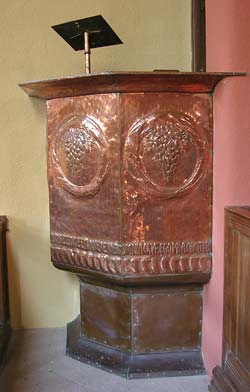 Henry Wilson, Pulpit for the Church of St Mark, Brithdir, 1898 Henry Wilson, Pulpit for the Church of St Mark, Brithdir, 1898 |