

 |
 |
 |
|
|
|


|
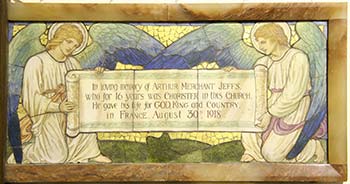
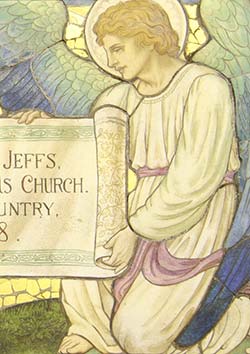
The Resurrection and a War MemorialAt St Katherine’s Milford HavenSt Katherine’s Church, Milford Haven was built between 1802 and 1808, probably to a design by the French shipwright Jean-Louis Barrallier or his son Charles. Barrallier, originally from Toulon, had been entrusted by Charles Greville, the nephew of Sir William Hamilton, with the speculative building of the new town of Milford, intended to service his new port and dockyard on the Haven.(1) The church was re-fenestrated in 1866–7, and enlarged with a new chancel in 1906–7, the architect on this occasion being John Coates Carter. The impressive western tower, which provides the climax to the broad promenade of Hamilton Terrace, was part of Barrallier’s original design. The ground floor serves as the entrance porch to the church, and here, on the south-east interior wall, is a glass mosaic panel, a memorial to Arthur Jeffs. It bears the inscription In loving memory of Arthur Merchant Jeffs, The inscription is contained within an unrolling scroll, held open by two kneeling angels. The figures are set on an undulating green sward, and against a background of gleaming gold, which provides a vivid contrast to their outspread wings. The wings shade from a greeny-gold to a deep blue at their tips. The features of the two figures are Pre-Raphaelite in their delicacy, that on the left being a young female, and that on the right a young male. Both look down at the inscription on the scroll between them.
The Angelic FiguresArt anthropomorphizes the angel. Gustav Davidson has pointed out that “angels are pure spirits, therefore bodiless and hence sexless” and Clara Erskine Clement earlier said that “they are created beings, therefore not eternal, but they are never old and should not be infantile”.(2) In the Bible they are always described in masculine terms, and Christian artists followed that convention, perhaps until the twelfth century. The angel in the guise of a child makes a first appearance then, and subsequently “the more secular approach of the Renaissance produced graceful angels with the faces of young girls or of ephebic young men”.(3) The angels in the Milford Haven mosaic are examples of this development.(4) The two angelic figures are both shown kneeling on one knee, in the position of genuflection. Clement made the point that this is not merely an artistic pose or decoration. Both kneeling and genuflection are postures of reverence and adoration. It here symbolizes the worship of Christ, and also “the angelic presence wherever Christ is worshipped”. The two figures themselves are “symbols of the glorious hosts of heaven who evermore praise God”.(5) They can thus be seen here as ‘Guardian Angels’, the protectors of humankind, who “while exempt from need and suffering, have sympathy with human sorrow, rejoice over repentance of sin, attend on prayerful souls, and conduct the spirits of the just to heaven when the earthly life is ended”.(6) This is clearly one of the roles played here by the two angels, as guardians of the departed Arthur Jeffs, the conductors of his soul to Paradise, and the comforters of those who mourn his death. The Biblical TextIt is necessary, however, to analyse the Biblical text which lies behind the composition. This is primarily Luke 24 verses 4–9: “And it came to pass, as they [ie Mary Magdalene, Joanna, Mary the mother of James “and other women that were with them” v.10] were much perplexed thereabout [by the stone being rolled away from the sepulchre in which the body of Jesus had been laid, ch.23 v.54; ch.24 v.2] behold, two men stood by them in shining garments: and as they were afraid, and bowed down their faces to the earth, they said unto them, Why seek ye the living among the dead? He is not here, but is risen: remember how he spake unto you when he was yet in Galilee, saying, the Son of man must be delivered into the hands of sinful men, and be crucified, and the third day rise again. And they remembered his words, and returned from the sepulchre, and told all these things unto the eleven, and to all the rest”. It can be shown that every stage of this narrative has important implications for the understanding of this mosaic panel. Firstly, Luke describes the two figures as clothed in “shining garments” (or, “dazzling apparel”). This image has considerably more impact than Mark’s equivalent (16 v.5) where the message is conveyed by “a young man” sitting inside the sepulchre and “clothed in a long white garment”. As C.F.Evans remarked, “an enigmatic figure for such an important moment”.(7) Matthew, however, although retaining the single messenger (28 v.2) heightens the drama considerably. He is unequivocal; the messenger is “the angel of the Lord” who, to the accompaniment of a “great earthquake” descends from heaven, rolls back the stone from the sepulchre, and sits upon it. “His countenance was like lightning, and his raiment white as snow” (v.3). Despite the crescendo of dramatic effect, from Mark through Luke to Matthew, there is a fundamental strand of agreement. The messenger (or messengers) were the ‘official’ messengers of God, angels. And, to reinforce this understanding, Luke uses the description ‘shining’ or ‘dazzling’ (astraptein) for their garments. For him, the shining or dazzling robe is the mode of description for an angel. It is interesting to note that, in this regard, a few verses later on, when Luke records the walk of two of the apostles with (an as yet unrecognized) resurrected Jesus to Emmaus, they discuss with Him what they call the “vision of angels” that the women had reported at the empty sepulchre (v.23). So, in addition to their role as Guardians, as outlined earlier, these angelic beings are also messengers. This identification with divine messengers is reinforced by the fact that in verses 5–7 they seem to impart their news by speaking in unison, almost as a “Greek chorus” commenting on the action.(8) Luke uses precisely the same device, two men in white who speak together, in Acts 1 verse 10, his second and more detailed account of Jesus’ Ascension into heaven. There is a striking similarity between the two narratives of Luke 24 and Acts 1. Firstly, both are introduced with the imperative “Behold!” (Idou) a word with a wide range of meaning, from ‘see’ to ‘take notice of’ to ‘comprehend’ and to ‘understand’. Then there are the white robes, and the two speaking in concert. But, above all, there is the import of the message conveyed; the proclamation of the Resurrection, and the interpretation of the Ascension, with its own concomitant proclamation of the Second Coming. It would seem evident that Luke intends his readers to see the two pairs of angelic messengers as one and the same.(9) Evans assists in the interpretation of these passages.(10) “The angelic utterance is the crux of the narrative in the synoptics: here is the voice of the ‘interpreting angel’ – a familiar figure in the apocalyptic literature – and through his voice the divine meaning of the event is disclosed.” For the resurrection, this is summed up in Luke 24 verse 6; because of Jesus’ resurrection, in fulfilment of his promise, it is pointless to search for the ‘living’ among the dead, ie those now alive beyond death. For the ascension, this is summed up in Jesus’ promise, in Acts 1 v.8, of the gift of the Spirit, in whose power his disciples shall be “witnesses”. It is therefore pointless to “stand gazing up into heaven” (v.11) when the disciples’ task is now to return to Jerusalem and await the fulfilment of the promise. In each case there is a disclosed meaning and interpretation, and in each case there is, implicitly or explicitly made, a promise. As noted earlier, this understanding underpins the implied message of the memorial to Arthur Jeffs. The Biblical Basis for the Jeffs MemorialThere is no doubt that the artist intended his angels to be seen as the messengers of the resurrection promise, in this case a promise of the hope of resurrection for Jeffs, who “gave his life for GOD, King and Country” (note the emphasis here, as well as the order), but also a promise with wider compass. Jeffs was a Christian, who had been for sixteen years a chorister assisting at Divine Worship in St Katherine’s Church. He had been baptized, confirmed, and a regular participant in the Eucharist. In this context, the promise of Jesus, recorded in John 6 v.47 would come to mind – “Verily, verily, I say unto you. He that believeth on me hath everlasting life” – in conjunction with verse 37: “All that the Father giveth me shall come to me; and him that cometh to me I will in no wise cast out.” The Jeffs memorial, then, speaks of the assurance of faith, faith in the risen and glorified Christ and in his promise, for the one commemorated and also for all those who turn to Him. That assurance is one that may only come gradually, as evidenced by the three women who come to the sepulchre to anoint the dead body of Jesus which they expect to find there. The angels, as Joel Green notes, address them as though they were on a quest.(11) The women are challenged to think through the implications of their actions: “Why seek ye…” (24 v.5)(12) The synoptic gospels all indicate that, despite the fact that the women had themselves received Jesus’ teaching on and promise of his resurrection (“Remember how he spake unto you [my italics] when he was yet in Galilee…” 23 v.6) they had failed to grasp its true significance and import, despite Jesus own emphasis upon its crucial importance at the time: “Let these sayings sink down into your ears…” (Luke 9 v.44).(13) The Jeffs Memorial, for those who stand before it, is designed to hammer home the message of the assurance of faith and of the verity of Christ’s promise. The women at the tomb are also reminded that Jesus’ obedience to and fulfilment of His Father’s will and purposes, involved suffering. Jesus had told them Himself: “The Son of man must suffer many things, and be rejected of the elders and chief priests and scribes, and be slain, and be raised the third day…Let these sayings sink down into your ears: for the Son of man shall be delivered into the hands of men.” (Luke 9 vv.22 and 44). It is through this remembering that the women are summoned, as Green says, to “authentic understanding”. The confirmation of their discipleship, and by implication and association, the discipleship of all Christian people, comes though their reception of the resurrection message and their conviction of its truth.(14) Although it is obviously not the intention of this memorial to establish an identity between the suffering, sacrifice and death of Jesus and that of Arthur Jeffs on 30th August 1918, what is established by the resurrection imagery of the mosaic in St Katherine’s is that he died possessed of a conviction of the truth of Christ’s promise, and that his death in war was not without meaning and purpose. The memorial is designed to continually challenge the observer with the question “Why seek ye the living among the dead?” and provide the answer, “He is not here, but is risen.” John Morgan-Guy Church of St Katharine, Milford Haven 1. There is a useful summary of the early history of Milford Haven in Thomas Lloyd, Julian Orbach and Robert Scourfield, Pembrokeshire (Buildings of Wales; Yale UP. 2004) pp.286–289. Sir William Hamilton’s wife Emma was the celebrated mistress of Lord Nelson, who visited Milford with the couple in 1802. He did not, however — as frequently claimed — lay the foundation stone of St Katherine’s. 2. Gustav Davidson, A Dictionary of Angels (New York, Free Press, 1967) p. xxiii; Clara Erskine Clement, Angels in Art (London, David Nutt, 1899) p.32. Davidson summarizes the ‘life-span’ of the angel very well: “Angels are immortal but not eternal. Their life-span started the moment they were ‘willed into being’; their end is ‘the last crack of doom’.” p. xxii. 4. Edouard Manet (1832–1883) had taken it still further in his Les Anges au tombeau du Christ, Le Christ mort aux anges in 1864. Here the two angels are both young women, in contemporary (nineteenth century) dress, only their widespread wings identifying them. 8. Perhaps significantly here, an action that has taken place “off-stage”. It is worth remembering that drama in this tradition, one which was almost certainly known to Luke, was always sacred. 12. Cf “Ye seek…”(Mk 16 v.6) which has to be read in the light of v.3, the women’s debate as to who would roll away the heavy stone from the sepulchre entrance, a debate that indicates that they expected to find the grave undisturbed and a dead body within it. Cf. also Matt.28 vv.5-6, which convey the same message of “ye seek…”
|
 Angel, detail from the memorial panel to Arthur Jeffs, c.1918, Church of St Katharine, Milford Haven |